The challenge
The construction sector is under pressure. Experienced machine operators are becoming harder to find, while the demand for road maintenance and new infrastructure keeps increasing. At the same time, safety requirements are getting stricter and sustainability targets more ambitious. For Heijmans, this raised a clear question: how can asphalt work be carried out with fewer people on site, without compromising on quality or safety?
The solution
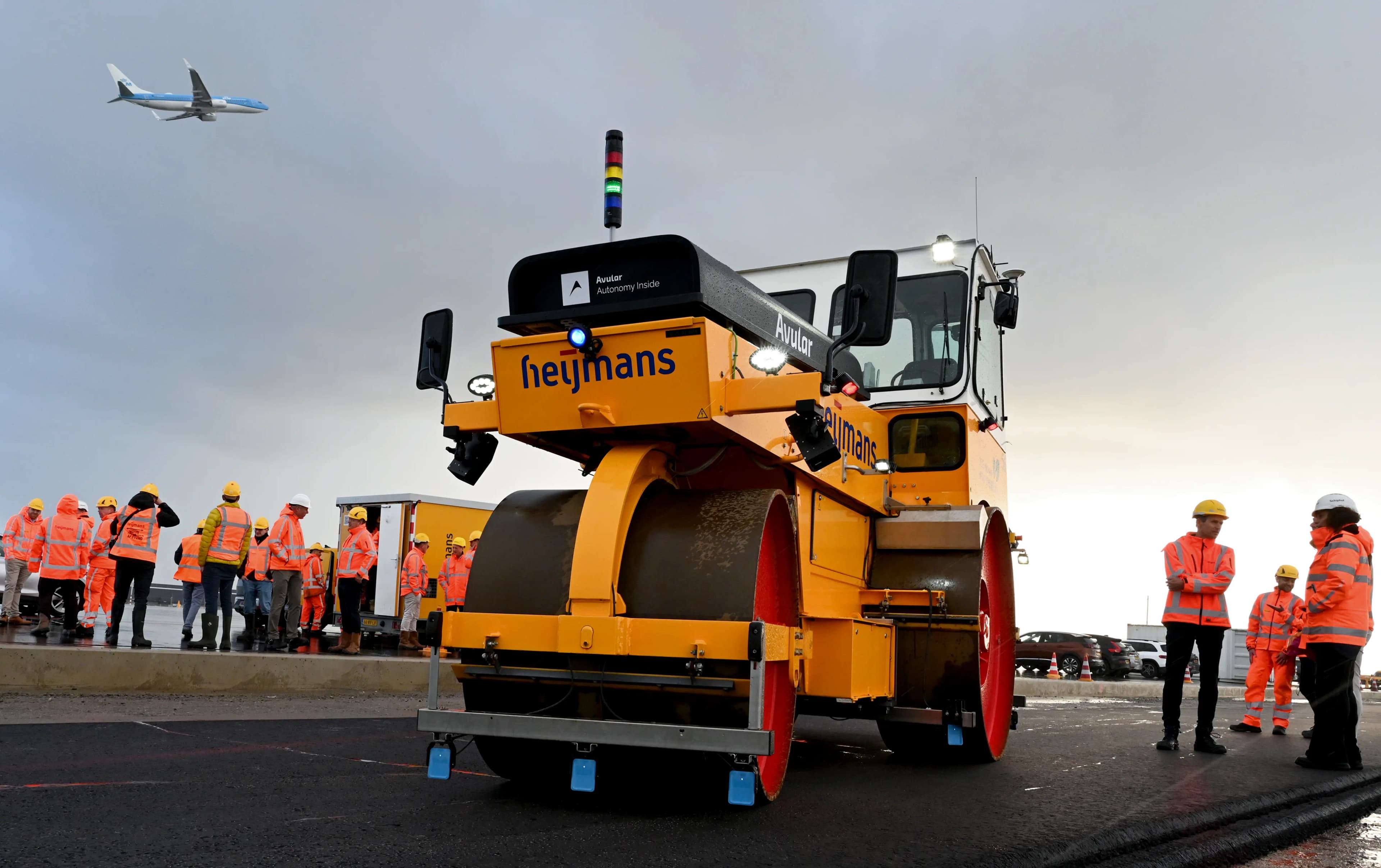
Together with Avular, Heijmans is developing an autonomous, fully electric asphalt roller. The roller follows a predefined path and performs the compaction process independently. Sensors continuously monitor relevant parameters, such as position and asphalt temperature.
The envisioned workflow allows an operator to prepare the job and supervise the process remotely, rather than sitting inside the machine. This could reduce the need for physical presence on the asphalt itself and, in the future, enable a single operator to oversee multiple machines simultaneously. The autonomous technology is being integrated into an existing roller, demonstrating how autonomy can be added to current construction equipment without requiring a complete redesign of existing workflows.
From prototype to real-world use
The autonomous asphalt roller was demonstrated live at Schiphol Airport: a complex, high-traffic environment where reliability and safety are critical. The demonstration confirmed that the technology can operate reliably and perform in real operational conditions.
Following this milestone, Heijmans and Avular continued testing and further development, with the goal of deploying an industrial version within its asphalt operations. In the longer term, this development has the potential to significantly reduce the number of people required on asphalt crews, allowing road construction projects to be executed more efficiently and contributing to a future-proof infrastructure in the Netherlands.